
The Province of Manitoba has declared the last full week of April as Invasive Species Awareness Week (C.C.S.M. c. I97). The Manitoba Weed Supervisors Association (MWSA) recognizes this week by highlighting two invasive plants that pose a significant threat to the agricultural landscape of our province. Certain invasive plants can often be mistaken for wildflowers. But unlike native wildflowers these species threaten agricultural productivity of both cultivated and non-cultivated land, waterways and natural areas.
The Noxious Weeds Act of Manitoba (NWA) (C.C.S.M. c. N110) requires control or destruction measures for different invasive plants. A comprehensive listing of noxious weeds can be found in The Noxious Weeds Act Regulations. The Act tiers plants according to their threat levels and specifies the areas of the province to which these levels apply. The Act requires that designated Tier 1 weeds must be eradicated without conditions. Examples of Tier 1 weeds are diffuse and spotted knapweed, orange hawkweed, red Bartsia (in most locations), Palmer’s amaranth and Tall Waterhemp. Tier 2 weeds are also a significant concern and include leafy spurge, common tansy, field scabious, and nodding thistle.
The MWSA is comprised of; and represents, Weed Supervisors who are individually employed by Weed Control Districts formed by one or more Municipalities. Weed Supervisors are authorized through the NWA to ensure problematic weeds are dealt with appropriately on all lands in the districts they cover. Weed Control Districts, first started in 1964, have developed programs to deal with invasive plants such as leafy spurge and red bartsia. Prevention measures, early detection and rapid response by Weed Supervisors are critical for protecting habitats and agricultural land from these types of invasive species.
This article will highlight the two pigweed species Tall Waterhemp and Palmer Amaranth and red bartsia.
Tall waterhemp and Palmer’s amaranth; as mentioned are both species of the pigweed family and have been in the Province’s problem weed in the spotlight the last few years due to the high rates of herbicide resistance, with some US States reporting Groups 2,4,5,9,14,15,27 resistance. The concern that if left unchecked, is severe economic loss particularly in row crops such as Corn and Soybeans but also in edible beans if trends continue. Studies in Ontario and in the United States have found a yield loss potential to be 90% and higher in corn and soybeans with severe infestations. The biology of tall waterhemp (Ameranthus tuberculatus) enables it to grow quickly, up to 2 inches per day, and plants that emerged in August can have viable seed by end of September. The amount of seeds produced per plant is also concerning. Up to 1 million viable seeds can be generated on the largest specimens with the average being over 500,000; making infestations increase exponentially if left unchecked. Palmer Amaranth, an aggressive and invasive weed also threatening Manitoba’s agriculture base. So far, the spread of Palmer is not as widespread as waterhemp. But; just like Waterhemp, Palmer Amaranth can have up to 1 million viable seeds. This large seed base can produce plant that will germinate efficiently once soil temperatures reach 18 degrees and will continue to germinate until freeze up. Palmer Amaranth can grow 2-3 inches with ideal conditions and plants as large as 12 feet have been found. Both of these pigweeds move similarly into new areas typically with migratory birds, feed, bedding, seed, and equipment. The first few plants may show up on field edges, low areas, and riparian areas bordering fields. It is recommended to pull and bag the plants as soon as they pop up as they tower above the crop canopy. Being that Palmer and waterhemp are part of the pigweed family, identification can be hard when seedlings are small. Smooth-stemmed like Tall waterhemp, its leaves are a little wider, more like redroot pigweed, but can be distinguished by the long petiole (stem like structure that attaches the leaf to the main stem). Petioles of Palmer amaranth are longer than the leaves, while its cousins have shorter petioles. Once plants reach reproductive stages, the seed heads and leaves are dead giveaways. waterhemp with longer leaves and smooth stems with long, thing seed heads. Palmer will be large and towering well above soybean canopies with long, snakelike seed heads sometimes up to 2 feet long.
To update the spread of tall waterhemp, to date it has been confirmed in 28 different municipalities with the majority being in the South East of the province but has been moving West and North year over year. Palmer’s amaranth had two plants found in Manitoba in 2021; a single plant was found in 2022 in the same area, with zero plants found in 2023 and another single plant found in 2024 in the same location.
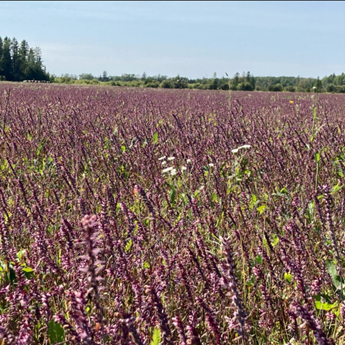
Red bartsia is a tier 1 weed in most of the province with the exemption of the Municipality of Bifrost-Riverton and the Rural Municipalities of Armstrong, Fisher, Gimli, Rockwood, St. Andrews and St. Clement being tier 2 due to high populations. In the last 2 years, the spread has increased into neighboring Municipalities mainly along roadsides but also pastures with movement of feed and bedding in drought years. Red bartsia will germinate late spring based on soil temperatures and growth is slow. Once the competition decreases, growth ramps up and can grow up to 12 inches tall. The plant has a hairy upright, wood like stem with narrow leaves up to an inch in length. Flowers are mostly on the top half of the plant and are found to be reddish-purple. Once maturity is reached, red bartsia becomes red in colour and heavy infestations will show a red tinge in the rangeland. A single plant can carry up to 1400 seeds and can have burr-like hairs on them using animals and clothing to increase the spread of the species. Chemical control is limited and timing is very important.
The problem with invasive plants is that they have characteristics that give an unfair advantage over native plants, pasture and grassland ecosystems, and cultivated crops. Invasives are not as affected by local pests and disease and often have vigorous growth which can allow them out compete native / desired plants. Invasives harm the environment by affecting soil and water quality and can threaten biodiversity by altering food chains and habitats or the introduction of a new disease. Invasive plants can directly affect humans by impacting the viability of traditional local foods and medicines, they can be poisonous / toxic and cause injury, becoming a fire vector, and reduce the enjoyable quality of outdoor recreational areas. What can be done?
Begin with prevention. Do not buy (or move) invasive plants. Each province has lists of regulated Noxious Weeds and Invasive Aquatic Species. Do not buy or move plants unless the seller includes a Latin name you can use to correctly identify it with a guidebook, Plant ID app, or an internet search. Secondly, identify and monitor the plants around you. Find out what plants are growing on your properties and use the tools mentioned or ask a professional (Weed Supervisor, Horticulturalist, Agronomist). Remove or keep track of invasives around you, and report high priority invasives to your local municipal Weed Supervisor or the Aquatic Invasive Species hotline (1-877-867-2470).